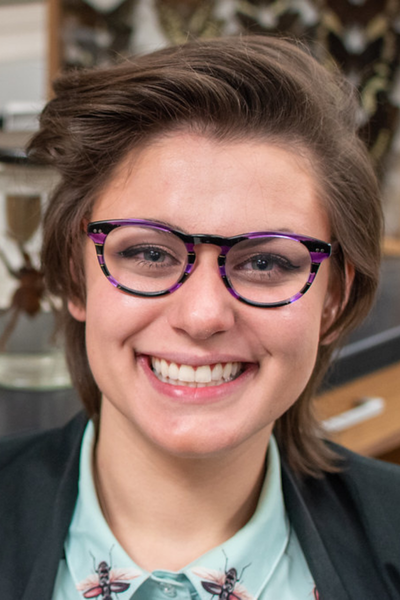
Abbey Hayes, Ph.D.
Abigail "Abbey" Hayes is passionate about arthropods, ecology, and student instruction.
Abigail "Abbey" Hayes, Ph.D., is passionate about arthropods, ecology, and student instruction. Hayes wanted to be a dentist when they started their undergraduate degree, but through interacting with faculty members and course content, that trajectory shifted. While their first two research projects worked on sea turtles and newts, they quickly realized their heart belongs with terrestrial arthropods. This drove them to a Ph.D. in entomology and two subsequent postdoctoral positions in which they continued to research arthropod phenotypes. Beyond creepy-crawlies, Hayes is passionate about community, in both the ecological and social sense, and looks forward to bringing their science and community organizing skills to VCU.
Q&A with Abbey Hayes
Where did you grow up? Can you tell us a little about your educational journey?
I grew up in Northern California where I did my undergraduate degree at Saint Mary's College of California. It was through the lab courses and research experiences during travel January terms that I discovered my love for ecology and left behind my pre-med dreams.
I then got a Ph.D. in entomology from Washington State University focused on understanding how and why bugs look the way they do. I went on to receive an NSF Postdoctoral Research Fellowship, which I took to the University of Connecticut where I continued researching insect phenotypes and taught a research engagement course over the four semesters I was there.
Most recently I was a postdoctoral research associate at the University of Virginia where I worked to understand seasonal adaptation of fruit flies and manage a large community science project focused on insects in compost piles, while also adjunct instructing at nearby Piedmont Virginia Community College.
When did you first fall in love with your field of study? What made you decide to work in academia?
I took a January term travel course to Mexico and did sea turtle research for roughly three weeks. Being able to see the tangible difference I could make in terms of conservation and caring for the animals and the planet as a scientist really ignited a spark that is still going. While doing research with an advisor I had connected with on that trip, I caught a moth and raised her caterpillar babies to get over a fear I had of caterpillars. In watching them develop, I became absolutely fascinated with how the insect and its environment could intersect to form very convincing camouflage, which is what sent me down the path of researching arthropod appearance. I have a tattoo of the moth to commemorate the insect that made me become an entomologist.
Can you talk a little about your teaching philosophy? What do you most like about teaching?
I care so much about inclusive pedagogy in my classes. When I was an undergraduate myself, I went through some very challenging life circumstances, and I was so fortunate to have faculty that listened and helped. I strive to provide similar experiences to my students to help every person that walks into my classrooms thrive. Through the use of universal design for learning principles and humanistic mentorship, I hope to uplift students at VCU regardless of their background or future aspirations. Education is for everyone.
What attracted you to VCU? What are you most excited about in regards to VCU and Richmond?
I love that VCU is a place that meets students where they are at and truly promotes social mobility through education. My grandfather had a middle school education, but worked incredibly hard to help my mother obtain an advanced education. I know how transformative education can be — not just for individuals, but also for entire families. Richmond has such a diverse and vibrant community, and I am really looking forward to having the chance to show students how wonderful the biology is around them, while helping them obtain transformative educational experiences.
Can you tell us either a quirky fact about yourself or some of your hobbies?
I have six pet tarantulas and four types of isopod (roly poly). I ran a bug zoo in grad school that we used for outreach and teaching, which reached around 3,000 community members every year.