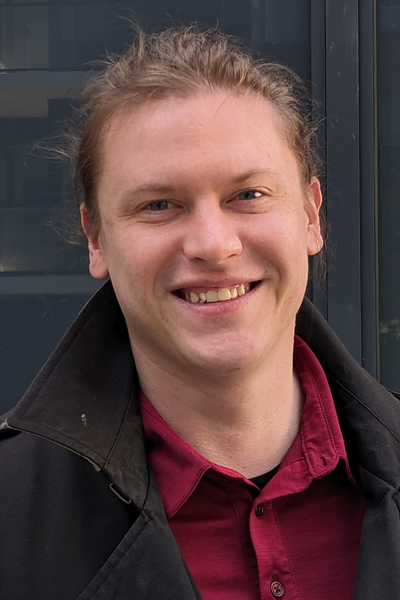
Adam Cook, Ph.D.
Cook’s research interests span synthetic chemistry, catalysis, chemical biology, medicinal chemistry, and drug delivery, with a particular emphasis on using chemistry to address major unsolved problems of global significance.
Adam Cook, Ph.D., is an assistant professor in the Department of Chemistry, where his research team places chemistry at the heart of solutions to problems in medicine and drug delivery. He earned his Ph.D. from the University of Ottawa under Stephen Newman, Ph.D., studying catalysis and the development of new chemical reactions, before completing postdoctoral research with Paul Wender, Ph.D., at Stanford University. Cook’s research interests span synthetic chemistry, catalysis, chemical biology, medicinal chemistry, and drug delivery, with a particular emphasis on using chemistry to address major unsolved problems of global significance. As an educator, he is especially passionate about the student experience, mentorship, and helping students discover the ever-expanding realm of where chemistry can take them.
Q&A with Adam Cook
Where did you grow up? Can you tell us a little about your educational journey?
I grew up in the small-ish town of Ajax, Ontario, about 40 minutes east of Toronto, right on Lake Ontario. That’s right – Canada! I achieved a Bachelor of Science at Ontario Tech University, a small but mighty institution located just a stone’s throw from my hometown.
After taking what I refer to as a “discovery year,” consisting of some odd jobs and lots of international travel, I began graduate school at the University of Ottawa, where I worked alongside Stephen Newman, Ph.D., to learn all about catalyses and how to design new chemical transformations. Upon graduation, I flew down to sunny California where I pursued post-doctoral work at Stanford University; working under the leadership of Paul Wender, Ph.D., I pursued various projects geared toward approaching solutions to major unmet medical challenges including cancer, infectious disease, and neurodegenerative disease.
When did you first fall in love with your field of study? What made you decide to work in academia?
Ever since I can remember, I’ve known I wanted to pursue a career in teaching; interestingly, my first thoughts of a “dream job” had me dreaming about becoming a high-school fitness teacher. How things have changed since then!
Enrolling in a chemistry program as an undergrad student, then, was almost a fluke, but I really fell in love with the discipline after spending the summer after second year working in the lab of Yuri Bolshan, Ph.D. And, I mean, how could one not fall in love with a discipline upon the realization that your own hands can be trained to manipulate the universe on a molecular scale? From there, the rest is history.
As for my decision to work in academia, I come from an unconventional personal background that was really shaped by valuable influences of teachers at various points. I owe it to the world to pay it forward, and hope that I can one day be that same influence for someone who needs it.
Can you explain the focus of your research?
All research in my group starts with a problem of global significance and works backwards to figure out how we can solve that problem using chemistry. On our research team, we choose to target medical problems; and when push comes to shove, we realize that an enormous number of medical problems boil down to problems associated with delivery: how we get molecules to where we want to get them, when we want them to get there. Our research program places chemistry at the heart of delivery science.
For instance, modern cancer treatment is plagued by an inability to selectively kill diseased tissues. While chemists have developed molecules capable of killing cancer cells, we have yet to find a way to do so without harming normal, healthy tissue. How can chemistry solve this problem? One arm of our research program seeks to address this problem by developing catalysts that operate under conditions reminiscent of those within our bodies. Then, we imagine methods to get these catalysts selectively to diseased tissue, where they can act as “catalytic drug factories,” unlocking chemotherapeutics, imaging agents, and a theoretically limitless amount of other bioactive compounds precisely at the site of diseased tissue.
Can you talk a little about your teaching philosophy? What do you most like about teaching?
For me, my whole story begins with, and ends with, teaching. My core role at VCU is that as a facilitator. Whether in class or in the lab, my number one job is to facilitate the growth of students from the place they begin to the place they want to go. The key word, of course, being growth – seeing the growth of students as human beings, not just as students in a classroom, is what I enjoy most about teaching. I am big on fostering an environment of intrinsic motivation, believing that pressure is only ever good if it comes from within and that the only person students should worry about competing with is the person that they were yesterday.
What attracted you to VCU? What are you most excited about in regards to VCU and Richmond?
In many ways, VCU reminds me of home: a community of individuals coming together to build something greater than the sum of its parts. The dual mission as a leading public research institution and a nationally recognized model for community engagement really resonates with me. As educators, it’s our job to jump outside of the university walls and into the community to teach, talk to, and inspire the community in which we exist. It takes a village to raise a scientist; likewise, it takes a scientist to raise a village.
Can you tell us either a quirky fact about yourself or some of your hobbies?
Painting! I love to paint landscapes, abstracts, horribly ugly renditions of humans (I’m working on that one), anything. Much like a research project, there is magic in starting with a blank canvas, and creating something that acts as a filter between that which exists in one’s mind and what can be interpreted by the public.