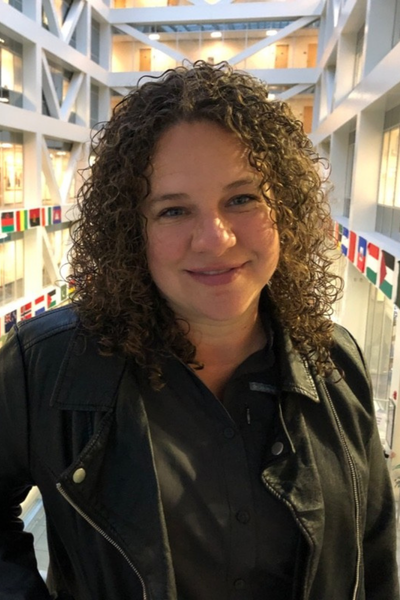
Staci Smith, Ph.D.
Over the past six years, Staci Smith has earned grants and awards, including a Fulbright Award to Slovenia in 2023 and two Arthur W. Page Center Legacy Scholar awards; one to study refugee communication and crisis management in communities and the other to identify imperatives for minimizing misinformation spread on social media for government communicators in which she worked with NATO.
Staci Smith, Ph.D., is an assistant professor in public relations in the Richard T. Robertson School of Communication. She graduated with her M.S. and Ph.D. in communication from Purdue University. Over the past six years, she has earned grants and awards, including a Fulbright Award to Slovenia in 2023 and two Arthur W. Page Center Legacy Scholar awards; one to study refugee communication and crisis management in communities and the other to identify imperatives for minimizing misinformation spread on social media for government communicators in which she worked with NATO. She recently published the book “Research Methods for the Marginalized” (Routledge) and has published several articles and presented at conferences in the United States and Europe.
Q&A with Staci Smith
Where did you grow up? Can you tell us a little about your educational journey?
I grew up in Reston and Herndon, Va. My bachelor's degree is in elementary and special education, K-12, and I taught in an autistic unit and fifth grade before I took 14 years to stay home to raise four sons. Once they were all in school I started back at Purdue University where I received my master’s and Ph.D. in communication, while bringing my four boys along the way.
Over the course of the last several years, they have been a big part of my educational journey. On my graduation cap it said, "4 Boy Mom.” We would sit at the table and do homework and they would travel with me while I taught in study abroad all over Europe. They were in the refugee centers volunteering right along with me when I did my Fulbright and my research. For me the journey to get my master’s and Ph.D. was the best part. The degree that hangs on my wall is important, but I sure had fun along the way.
When did you first fall in love with your field of study? What made you decide to work in academia?
I have always loved teaching, but fell in love with research when I started working with refugees and doing community-based research. It was then that I realized that research could have an impact — you can see the results your research has on people. Doing community-based research definitely takes longer than other research types like surveys because you have to spend time with individuals and communities.
While I was a Fulbright Scholar in Slovenia, I spent so much time serving at refugee centers both in the country and throughout Europe, getting to know the people I did research with on a personal level. I have taken my sons with me to volunteer in refugee centers, and the impact I've seen on them is significant. Seeing my research have an impact for good really puts the value of doing research into perspective. In fact, I recently published a book called, “Research Methods for the Marginalized,” which is based on my experiences working with refugees and other vulnerable populations on how to conduct research with positive social impact.
Can you explain the focus of your research?
Broadly I look at coping and resilience in a crisis. I started with PTSD and veterans with my master’s thesis. For my doctoral dissertation, I analyzed big data regarding terrorist attacks to examine how people cope with crises using social media. I love looking at ways that people build resilience through communication and community interaction.
Most recently, I did research with female refugees in five European countries and the United States, documenting their stories. I was taken aback when one told me, "You want to hear my story? Nobody ever wants to hear my story." Just this past year, I completed a grant to do research with NATO on how to help stop the spread of misinformation, and I had the opportunity to train NATO communicators with the research results at NATO headquarters in Belgium.
Can you talk a little about your teaching philosophy? What do you most like about teaching?
I think to learn you can't always be behind your computer. Learning is not a passive experience. I'm not much of a lecturer. Instead, I prefer hands-on application. Students often comment that in my class you shouldn't expect to just sit and take notes, but rather, to expect to be involved and get to know your fellow classmates. They often comment that they never get to know their classmates as well as they do in the classes I teach because I require them to interact.
What attracted you to VCU? What are you most excited about in regards to VCU and Richmond?
I grew up in northern Virginia but hadn't spent any time in Richmond. I love that VCU has a diverse student body, which really speaks to my teaching and research. Its Research 1 status also really attracted me to VCU.
Can you tell us either a quirky fact about yourself or some of your hobbies?
I love to roller blade while listening to really loud music. One time I was recruited to be on the local roller derby team, but I declined because I believe roller blading is more of an individual sport. I love to read and escape into another world. I like making food. I also like shopping secondhand. The potential to thrift something unusual is thrilling to me. Finally, I love traveling and have lived all over the U.S. and the world, from Slovenia to Thailand. I was fluent in Thai in my 20s. I can't wait to discover all things Richmond.